AI Solved Search. Now Researchers Have a Bigger Problem
UNITED KINGDOM / AGILITYPR.NEWS / May 14, 2026 / Artificial intelligence has dramatically changed how research is conducted. Finding papers, sources, and information that once took hours can now happen in seconds. But as AI accelerates access to knowledge, many researchers are encountering a new challenge: understanding what actually matters.
Researchers today are not struggling to find information. They are struggling to navigate it.
From academic journals and PDFs to AI-generated summaries, notes, and web sources, modern research workflows are becoming increasingly fragmented. Researchers can gather dozens of relevant papers in a single session, only to find themselves overwhelmed by disconnected information, overlapping ideas, and no clear sense of how concepts fit together.
ResearchCollab.ai describes this emerging issue as the “discovery gap”. This is the growing divide between accessing information and understanding how ideas connect across a wider landscape.
“Search has effectively been solved,” said Imran Chughtai, Founder and CEO of ResearchCollab.ai. “The real challenge now is discovery. Researchers do not need more information thrown at them. They need help understanding relationships, patterns, contradictions, and gaps across what they’re seeing.”
The shift is changing how research itself is approached. Instead of spending most of their time locating material, researchers are increasingly focused on synthesis: identifying connections between ideas, tracing how one concept influences another, and understanding how insights from different disciplines intersect.
According to ResearchCollab.ai, traditional search-led workflows are poorly suited to this kind of exploratory thinking. They are designed to retrieve information quickly, but not necessarily to help researchers visualise how ideas relate or where opportunities for new thinking might emerge.
Many of the most important breakthroughs happen between disciplines, where concepts from one field reshape thinking in another. Yet these connections are often difficult to identify when research remains linear and fragmented across multiple tools and platforms.
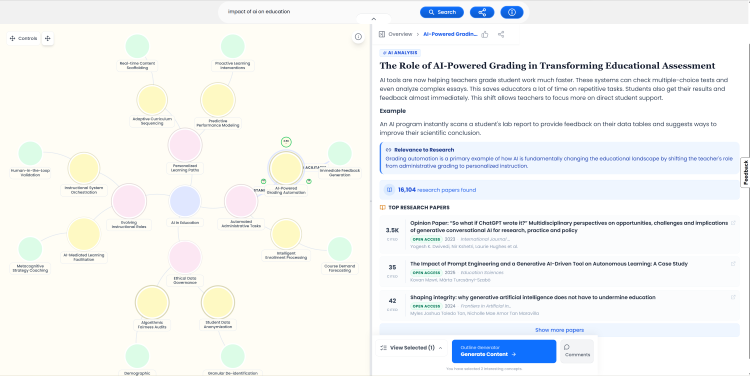
ResearchCollab.ai has been built around this changing reality. Rather than focusing purely on faster retrieval, the platform is designed to support discovery-first research workflows, helping users explore how ideas overlap, cluster, and evolve before narrowing down conclusions.
Instead of returning a single “best” answer, the platform allows researchers to visually map topics, follow relationships between concepts, and maintain the thread of enquiry across search, reading, analysis, note-taking, and writing.
“AI should not just retrieve information,” Chughtai said. “It should help researchers see the structure behind it. That is where discovery happens.”
The platform’s approach reflects a wider shift taking place across academia, research, and knowledge work, where the growing volume of information is making interpretation and synthesis increasingly valuable skills.
As AI continues to reshape how knowledge is gathered and processed, ResearchCollab.ai argues that the next phase of innovation in research will not be about speed alone, but about helping researchers move from information to understanding.
For more information, visit researchcollab.ai.
Contacts
Dakota Digital
socialmedia@dakotadigital.co.uk