Blocks, Bubbles and Big Thinking: The Power of Early STEM Play
UNITED KINGDOM / AGILITYPR.NEWS / March 03, 2026 / The next generation of engineers and innovators may be closer than we think, busy stacking blocks, mixing colours and asking “why?” for the hundredth time. Long before children sit at desks or open textbooks, they are already experimenting, testing and problem-solving. The award-winning science program, Mini Professors believes that is exactly where STEM should begin.
While many families still associate STEM with secondary school laboratories and exam timetables, a growing body of evidence suggests that the foundations for scientific thinking, problem solving and creativity are laid much earlier.
Research from the Harvard Center on the Developing Child found that in the first years of life, more than one million neural connections form every second. These connections are built through everyday experiences and interactions, forming the architecture of the brain. Responsive, stimulating environments do not simply entertain toddlers; they actively shape cognitive development, language acquisition and emotional regulation.
Within this context, Mini Professors believes STEM-based play is not an optional extra, but a vital part of early childhood - a view supported by recent academic research.
A recent paper published on the Journal of Experimental Child Psychology found that guided play and the use of STEM-related language were linked to stronger early maths and spatial reasoning in preschoolers.
Similarly, a 2025 review in the International Journal of Social Science and Economic Research noted that early STEM exposure contributes to improved problem-solving abilities, logical thinking and collaborative skills.
But don't imagine toddlers sitting in a classroom: STEM at this age does not resemble formal lessons. Studies exploring technology-enhanced toys show that children aged three to four demonstrate early engineering thinking when sequencing simple programmable devices, predicting outcomes and adjusting their approach after trial and error - and that imagination-led exploration can nurture motivation and curiosity in science from the earliest years.
Abi Davis, Director at Mini Professors, said, “For toddlers, STEM isn’t about formal lessons, it’s about exploration. When children build, splash, sort, question and experiment through play, they’re developing critical thinking, language skills, coordination and confidence all at once. Play-based STEM learning taps into a child’s natural curiosity and turns everyday moments into powerful foundations for problem solving and resilience later in life.”
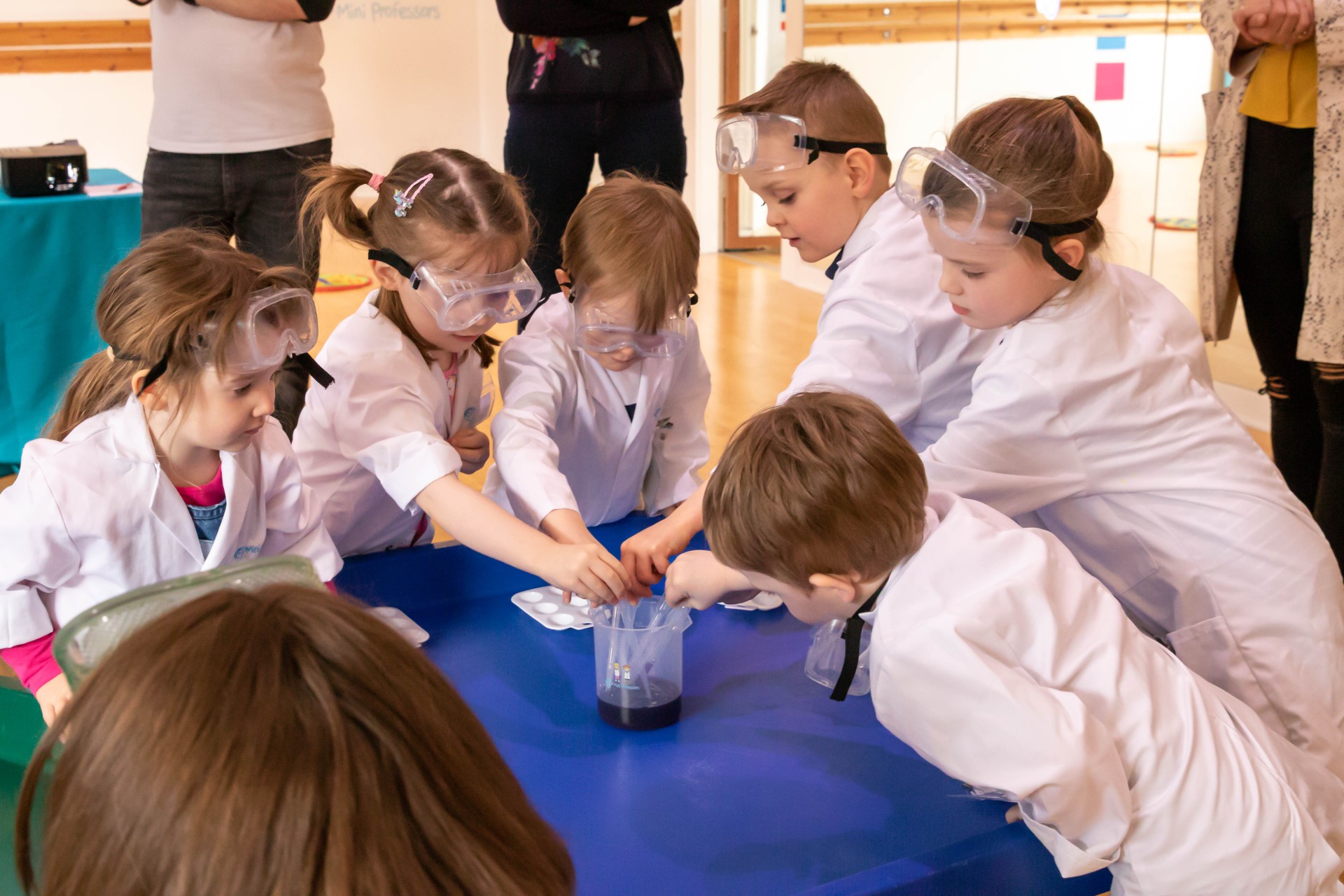
In practice, this can be remarkably simple. For two- to four-year-olds, STEM might involve mixing coloured water to observe changes, building towers and testing balance, sorting objects by size or texture, exploring magnets, or predicting which items will float or sink. Measuring flour while baking introduces early mathematical language, while planting seeds encourages observation and patience. Each activity builds vocabulary, reasoning and confidence through hands-on discovery.
Children who develop analytical thinking, adaptability and confidence early are better prepared for later academic achievement and participation in a knowledge-driven economy. This is what makes nurturing curiosity and problem-solving from the outset a shared social and economic priority.
Abi Davis added, “Nurturing STEM skills in the early years is an investment in our collective future. The curiosity, creativity and analytical thinking developed in those formative years underpin the skills our society and economy increasingly depend on. By embedding STEM confidence early, we’re helping to build a generation that is adaptable, innovative and equipped to thrive in a rapidly changing world.”
Through its hands-on classes for children 2 - 12, Mini Professors shows STEM is not reserved for older children. Instead, it begins with a question, a splash, a stack of blocks and the freedom to explore - laying foundations that can last a lifetime.
For further information, visit: https://www.miniprofessors.com.
Contacts