
Cultural Survival Calls for Action to Protect Indigenous Defenders in New “Defending the Land, Paying with Life” Report
NEW YORK, NY / AGILITYPR.NEWS / April 23, 2026 / States, Companies, and International Human Rights Bodies Must
Defend Indigenous Land Defenders
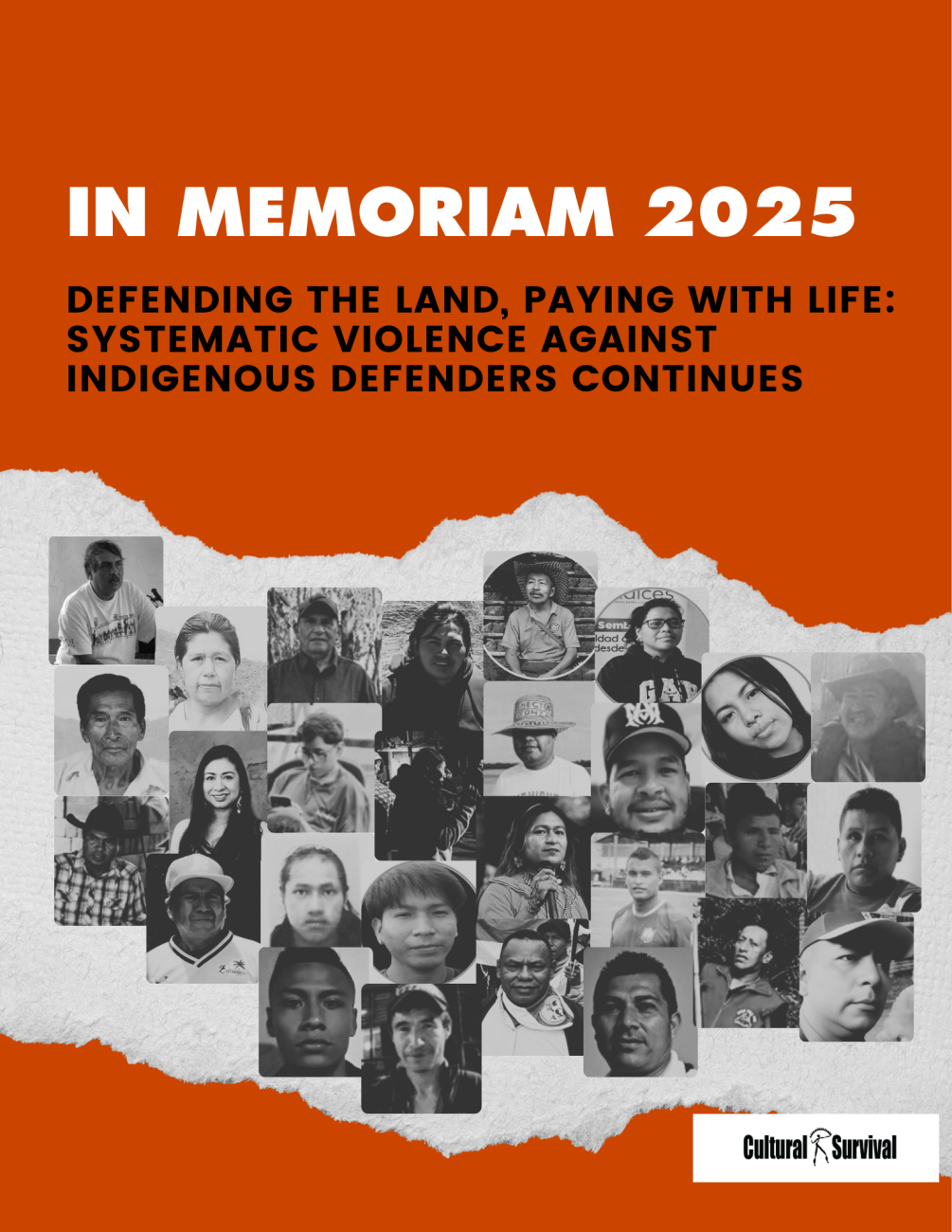
On March 10, 2026, Indigenous Peoples’ rights organization Cultural Survival published its annual "In Memoriam" report documenting the 2025 murders of Indigenous land and rights defenders across Latin America.
Today, at the 25th session of the UN Permanent Forum on Indigenous Issues, Cultural Survival releases an advocacy brief, “Defending the Land, Paying with Life,” that analyzes the structural violence behind these murders in the context of international human rights legal frameworks and launches recommendations towards the parties responsible for protecting defenders and implementing Indigenous rights, including companies, States, the UN Permanent Forum on Indigenous Issues, the Presidency of COP Escazu’s governing board, and the international community.
It is well documented that Latin America is the most dangerous region in the world for defenders of the right to land and territory. In 2024, 82% of the 146 documented cases of murders of defenders took place in this region. Two of the most lethal countries for defenders are Mexico and Colombia, both of which have protection mechanisms for defenders. Yet despite the existence of such mechanisms, defenders continue to lose their lives, as well as face threats, intimidation, kidnappings, physical and digital attacks, and other forms of violence that seek to make their defense work impossible or unsustainable.
Cultural Survival’s report names and honors specific Indigenous defenders who were killed for living in service to their communities and to the living ecosystems also inhabiting their territories. They were killed for doing work upon which the rest of the planet depends: protecting forests and waters and defending against the extractive projects that contribute throughout their supply chains to climate change and other environmental disasters.
The report highlights a multitude of international human rights standards and precedents, including the UN Declaration on the Rights of Indigenous Peoples, International Labor Organization Convention 169, the International Covenant on Civil and Political Rights, and Inter-American Court of Human Rights precedents, which lay the groundwork for States’ obligations to take concrete steps to implement the rights of defenders.
Key Recommendations
- To States: Stop criminalization of defenders, from direct state actions bringing falsified cases against them to unofficial intimidation, threats, and physical violence; and investigate and prosecute these actions when they occur.
- To States: Put an end to state discourse falsely associating defenders’ actions with crimes such as terrorism.
- To States: Recognize and demarcate Indigenous lands and territories in accordance with Indigenous Peoples’ requests and respect Indigenous rights to make decisions about them so that defenders are not forced to put their lives on the line.
- To States: Strengthen the role of mechanisms for the protection of Indigenous defenders, allocating sufficient resources and encouraging the involvement of Indigenous Peoples and communities in their development.
- To Companies: Implement human rights due diligence policies with differential risk assessments for Indigenous Peoples and Indigenous defenders that cover the entire value chain, include accessible redress mechanisms, and expressly prohibit the use of legal actions to criminalize territorial and environmental defense.
“Every name in this report is a universe that was extinguished, a language, a territory, a form of knowledge that the world will never recover. In memoriam is not an act of mourning; it is an act of resistance,” stated Alicia Moncada (Wayuu), Cultural Survival Director of Advocacy and Communications.
###
About Cultural Survival
Cultural Survival (CS) is an Indigenous-led NGO and U.S.-registered non-profit that advocates for Indigenous Peoples' rights and supports Indigenous communities’ self-determination, cultures, and political resilience since 1972. For over 53 years, Cultural Survival has partnered with Indigenous communities to advance Indigenous Peoples' rights and cultures worldwide. CS envisions a future that respects and honors Indigenous Peoples' inherent rights and dynamic cultures, deeply and richly interwoven in lands, languages, spiritual traditions, and artistic expression, rooted in self-determination and self-governance. The core of Cultural Survival’s efforts rests on the principles of supporting, amplifying efforts, and raising awareness of self-determination for Indigenous communities. To learn more, visit www.cs.org
Contacts
Agnes Portalewska
agnes@cs.org