HOW TO CHOOSE A PANIC BUTTON SYSTEM SOLUTION
JUPITER, FL / AGILITYPR.NEWS / September 13, 2021 / All panic button solutions have the same goal - to expedite awareness of and response to crisis events, like active shooters. But not all systems are created equal. As you evaluate panic button solutions for your school or business, make sure to ask yourself these questions.
1) Who can initiate the panic button and what information does it share with staff, security, those in danger, and first responders?
- A best practice is to empower your staff to be able to summon the right help and resources from wherever they are.
- The most powerful panic button solution greatly expedites awareness and response as well as enabling users to directly connect with first responders and send detailed, situation-specific notifications to a custom list of recipients.
- Because staff moves around in the building, it’s imperative that the tool can confirm exactly where each user is when they initiate a panic button and send alerts based on that location.
2) Does the system connect with police dispatch?
Being in an emergency can jeopardize your ability to clearly communicate with first responders, whether it’s due to stress, fear, losing connection, or being in a situation where you cannot verbally share critical details.
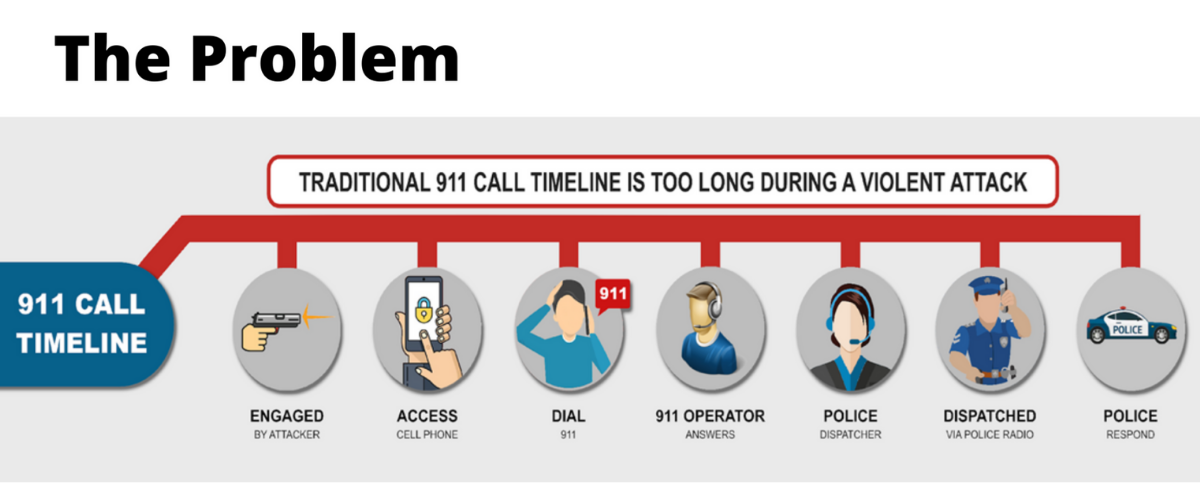
Calling 9-1-1 is not calling police dispatch. Calling 9-1-1 is a step in the process of getting to police dispatch.
- Most solutions available today do NOT connect users to police dispatch and instead route the call through a 3rd party call center. This wastes valuable time in a crisis situation.
- Still, other systems connect to 9-1-1, which again is a step that slows down the process and is oftentimes inhibited by the caller's inability to verbally communicate.
- A few systems do utilize enhanced 9-1-1 connections that use location services, but this is done only via a phone application. This too can present an issue in a crisis.
- Studies have proven that performing simple tasks, such as entering your passcode into your phone, then dialing 911 can be nearly impossible for most people when their lives are in danger.
- App activation requires you to unlock your phone, then scroll to find the app that you never use, open it, then scroll through the list of options, locating the type of emergency that pertains to your situation, then entering the number of fields required to identify and validate your request for that particular emergency response.
- All of this assumes that your mobile device is on your person during the onset of the event. NOTE: Most schools and many businesses do not allow cellphones to be turned on and in hand throughout the day.
- Apps are fully dependent on WIFI or cellular for connectivity.
- Visitors to a building or campus would not have the App on their devices or be trained on how to use it.
A Best-Practice panic alarm system should include:
- A dedicated hardware system (buttons) in convenient locations throughout the building. Having dedicated hardware that is readily accessible and easy to operate is KEY when it comes to life-saving tools. There is a reason fire alarms are on the wall and not activated via a phone application.
- Building-wide alerts that do not require a cell phone to know what is happening.
- If an application is utilized in the solution, it should be as a compliment and add to the redundancy of a more robust solution.
3) Is it in compliance with state mandates such as Alyssa’s Law?
Named in remembrance of Alyssa Alhadeff, a victim of the 2018 Marjory Stoneman Douglas High School tragedy, Alyssa’s Law is critical legislation that addresses the issue of response time when a life-threatening emergency occurs. The law, already passed in New Jersey and Florida and is pending in many other states (Arizona, Nebraska, New York, Nebraska, and Texas). There is even a push to pass Alyssa's Law on a national level.
4) Are first responders able to access critical school data like camera feeds and floor plans?
Emergency response hinges on everyone having the information they need to act. In addition to alerting what is happening, where it is happening, and who it is happening to, having a panic system that easily integrates with other existing technology is another important feature to consider.
5) How does the panic button solution alert those in danger?
Alerting first responders that there is a crisis is only an initial step in emergency response. The panic button should also alert those in danger as well. It needs to be obvious to anyone, trained or not, that an emergency situation is happening. This can only be reliably communicated with visual strobes and/or audible sirens. This is because users should not be made to rely on receiving critical life-saving information only from their cell phones as cell phones:
- May NOT be on their person.
- May NOT even be turned on.
- May NOT receive a reliable connection at all times.
6) Can the panic button solution be customized to your specific needs?
Every business or school has different priorities, procedures, and challenges. The best technology is customizable to align with your needs. Customizing your panic button solution to your emergency response protocols ensures that staff stay in compliance with your policies and are speaking the same language during an emergency. Even as your protocols evolve over time, you can be confident that everyone is following your latest, most up-to-date procedures.
Can the panic button help organizations respond to everyday, localized incidents? Planning for wide-scale emergencies is critical, but issues related to localized incidents are more frequent.
A best practice system should have options for:
- Crisis situations like an active shooter
- Medical Emergencies
- Urgent Security Needs
- Weather-Related Emergencies
- Hazmat Emergencies where applicable
7) Does the panic system "think" like a first responder and victim?
FIRST RESPONDERS
For first responders, the major lesson identified from any mass casualty incident caused by extreme and focused violence is the need for rapid and accurate communication. The extreme stress of the situation, the confusion of the situation, and any lack of communications systems all add to the initially confusing scene and delay the ability to gather and form a common operating picture that then leads to organization and order. Organization and order are necessary to save more lives in a crisis event.
High levels of communication aid command and control, and without that, any event or operation is guaranteed a poor outcome. This is one lesson we must learn and take away from past tragedies. To learn more from an EMS perspective click here.
VICTIMS
Do you have your phone on you? Do you have cell reception in the building? Do you need to remain silent so as to not identify your location to the shooter?
These are all valid and real-world issues that people in emergencies face. How many of us work in buildings that never have good cell reception? How many students or school employees are even allowed to have their phones on them? Some businesses don't even allow employees to have their cell phones (as was the case with the FedEx shooting in Indianapolis). Life circumstances need to be considered as a part of your mental preparedness and situational awareness. Planning ahead to mitigate issues with first responder communication is a new tool for active shooter survival.
Consider the science of a typical brain during fear response. People have reported:
- Loss of sight
- Loss of hearing
- Normalcy Bias (i.e. an innate desire to not overreact causes us to underreact)
- Memory loss or gaps
- Freezing or feeling locked in place, some even to the point of paralysis
- Cortisol and adrenaline surges causing blood pressure and heart rate increases making the fear response stronger
- Loss of bowel control
- Loss of time or perceived time continuum slowing/accelerating
- Auditory perception changes (hearing something that seems close when it is far (or vice versa), garbled or muted sounds, overly loud or distorted sounds.
- and many more unexplained perceptions
In a fear response situation, a person may very likely NOT BE ABLE to communicate effectively to responding authorities (i.e. when calling 911 when under attack from an active shooter). Therefore, having a simple and somewhat "thoughtless" process for victims becomes a critical component to getting first responders the life-saving information they need.
Additionally, individuals need to also understand what actions to take as they escape the danger. Simple details such as displaying empty and raised hands when confronted by arriving authorities so as not to be mistaken for the threat. An organization can do a lot to help its employees and invitees by implementing active shooter protocol training and making certain to practice said training.
Bottom Line, an effective panic alert system needs to communicate:
- with dedicated hardware,
- with zero thought and mental acuity,
- instantly and reliably,
- with actionable information for both first responders and victims,
- directly with first responders (bypassing call centers and 9-1-1)
- in a way that allows immediate implementation of organization crisis protocols so that everyone is on the same page.
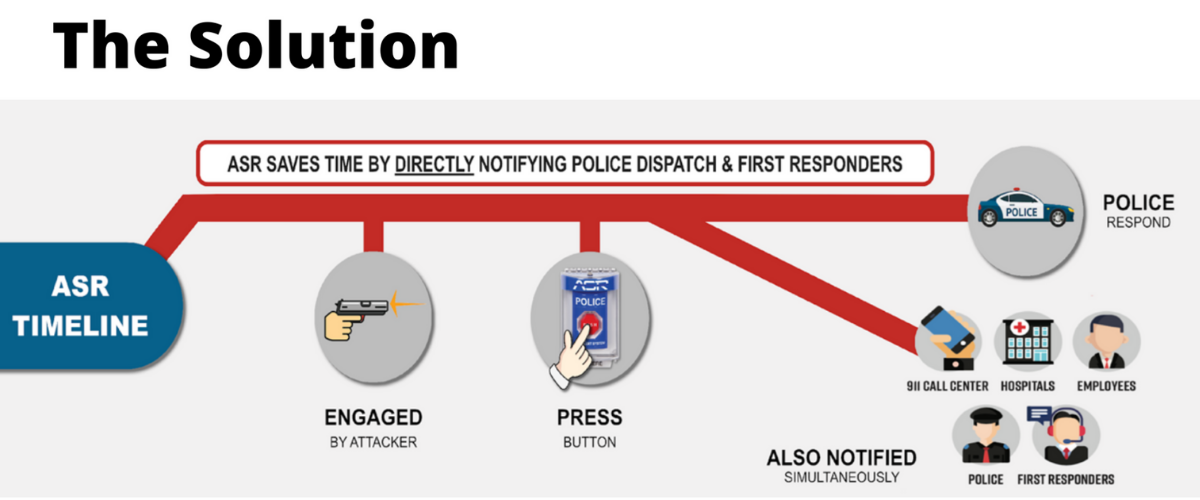
ASR Alert Systems is a patented state-of-the-art critical incident response technology specializing in the field of alert notifications to Law Enforcement and First Responders in the event of an active shooter or other crisis. Our technology can be customized to any industry, building, or event. We deliver customer-specific technology unmatched by anyone. With the PUSH of A BUTTON, the life-saving critical information of your situation is sent DIRECTLY to police dispatch.
The ASR system reaches dispatch and 911 simultaneously and also has the ability to text local officers on the ground - all at the same time, delivering all the information to everyone within seconds. We hold the patent on this technology.
Our critical incident response technology uses hard-mounted buttons, mobile pendants, and an optional mobile phone application to DIRECTLY communicate with first responders in the area to significantly decrease response times to an active threat or crisis situation.
Have questions or wish to schedule a virtual demonstration? Please contact us.
Contacts
Shay Discepolo
Marketing
Shay@ASRAlertSystems.comJupiter, FL
Phone: 1-800-722-7601
https://www.asralertsystems.com/blog/choosing-a-panic-system