
Responding to the Current Challenges for Our Patients, Our Staff and Our Communities
UNITED KINGDOM / AGILITYPR.NEWS / April 29, 2020 / The operational challenges currently facing Air Ambulances have kept the teams at Devon Air Ambulance (DAA) focussed on finding sustainable solutions to protect our patients and our staff and help our communities.
“We are involved in an industry-wide effort and collaboration to tackle various aviation factors that will enable the organisation to resume its air operations", explained Ian Payne, Flight Operations Director of Devon Air Ambulance "and are very grateful to the businesses and regulators who are all working together on three key initiatives.”
A prototype separation barrier has been fitted to both our EC135 helicopters that enables separation between the pilot and patient/clinical team. The separation barrier has been designed by submarine engineers at Babcock Marine in Plymouth and the design team at Babcock Mission Critical Services Onshore in Gloucester, manufactured in Spain and approved through the EU and UK regulators in consultation with the aircraft manufacturer Airbus Helicopters UK.
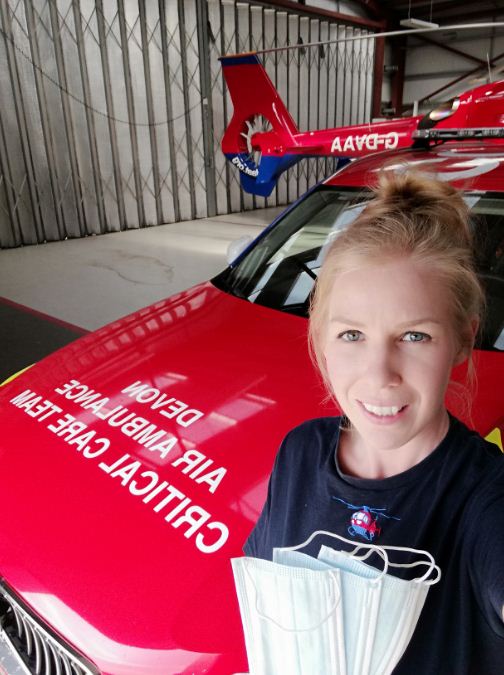
Also, as recommended FFP3 face masks are not compatible with aircraft ‘boom’ microphones (used for internal and external comms), our partners at Headset Services Limited are working on a new throat microphone to improve aircrew communications. This new mic fits around the neck and feeds your voice into the normal aircraft comms system. After a recent successful trial, we have placed an order for several sets of these new microphones.
Lastly, we have been looking at ways to improve aircrew Personal Protective Equipment (PPE). The use of full-face visors is an important part of PPE when certain medical procedures (where there is a higher risk of transmitting Coronavirus by airborne particles) are carried out. Until recently there was no approved mechanism to secure these visors to aviation helmets. More good news however as Babcock Marine (in Plymouth) have designed a new bracket which will enable full-face visors to be attached to safety helmets.
"Alongside these exciting developments our Patient Services team have been busy looking at ways we can protect and enhance our clinicians working environment (to safeguard them and our patients) and at what we can do to help the region-wide fight against Coronavirus" said Nigel Hare, Operations Director of Devon Air Ambulance.
He added “There’s no doubt that global pressures on supply chains mean that we are spending more time sourcing PPE, but our focus is also on the day to day training that is required to help our teams carry out their work safely.”
“Based on Public Health England’s recommendations we need to train in standard or Level 2 PPE and Level 3 PPE, which we need to use when carrying out Aerosol Generating Procedures (AGPs). AGPs, which include intubation and manual ventilation, are procedures that place our paramedics at a higher risk of catching the Coronavirus through airborne transmission.”
Training in the effective use of PPE starts with learning good practices in terms of ‘donning’ PPE (the process of putting on and fitting coveralls, face masks, face shields and gloves) and ‘doffing’ PPE (the process of taking off PPE to avoid cross contamination). Our paramedics have also had to get used to performing procedures wearing equipment that restricts their movement and vision which can also be uncomfortable (it can get very hot wearing PPE). These new operating standards place additional pressure on our paramedic’s working environment in what was already an exacting job.

We are extremely grateful to Luminous Show Tech and our colleagues at Wiltshire Air Ambulance and Kent, Surrey & Sussex Air Ambulance who have helped provide us with PPE. Please get in touch you can help us secure more supplies of essential PPE.
“Although much of our work has been focussed on what we can do to protect our patients and staff in the pre-hospital setting, we are also helping to support the wider healthcare effort against Coronavirus" added Nigel Hare. "Once we saw the potential impact of the virus on our hospitals, we took the decision to release our doctors back to their host hospitals on the basis they would be able to treat many more patients there than they would in the pre-hospital environment.”
“We are proud to be supporting the South West Critical Care Network and five of our paramedics will be helping with the specialist transfer of patients between hospitals. That work is linked to the new Nightingale Hospital based in Exeter. Our highly experienced paramedics - who can provide a suite of enhanced skills - are currently in training alongside other critical care specialists as we help build our region-wide response and resilience to meet the Coronavirus pandemic.”
“We’d like to take this opportunity to thank all our colleagues across the NHS - please stay at home, protect our NHS and help save lives.”
About Us
Devon Air Ambulance
Devon Air Ambulance Trust is the Charity which raises the funds to keep Devon’s two Air Ambulances flying. In March 2020 the charity also introduced two Rapid Response Critical Care Cars to their fleet of vehicles. The service is 29 years old and is funded by the generosity of the community, businesses and friends of Devon. Last year the helicopters assisted 985 patients, of which 10% were children. The Exeter based aircraft operates until 2am every day and in 2019 it was called to 139 patients in the hours of darkness using a growing network of Community Landing Sites.
Contacts