Swann Auction Galleries to Sell Rare Pictorial Map of How the Stars Lived in 1937 Hollywood
UNITED KINGDOM / AGILITYPR.NEWS / February 10, 2020 / Part of a huge selection of designs offered in February 13 auction
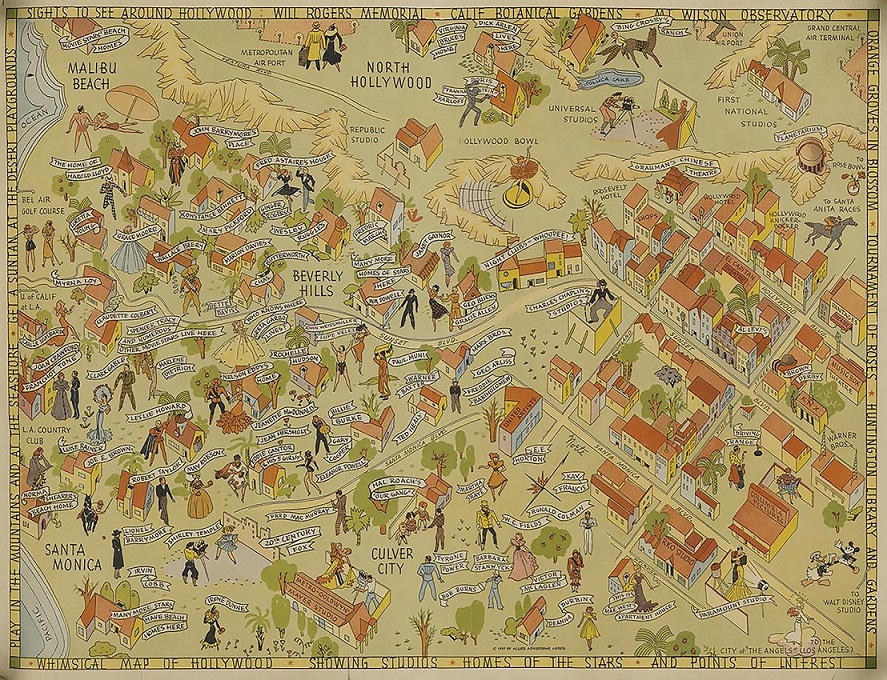
Swann Auction Galleries will take bidders back to the golden age of Hollywood with this pictorial map of Los Angeles showing the studios and where the stars lived in 1937. It is one of hundreds of lots in their Vintage Posters auction on February 13.
A fascinating glimpse into the lives of the screen icons of the day, the rare map gives an overview of names that have survived as major figures in the public imagination to this day, as well as those who have faded from view.
Close to Malibu Beach lived the silent movie hero Harold Lloyd, whose precarious antics high up on the side of tall buildings made audiences catch their breath. Two years before he conquered Hollywood as Rhett Butler in Gone With The Wind, Clark Gable could be found living next to the British actor Leslie Howard, his rival in the film for the affections of Scarlett O’Hara.
The Best Actor and Best Actress Oscars for 1937 went to Paul Muni for The Story of Louis Pasteur and Luise Rainer for The Great Ziegfeld. Rainer was also a neighbour of Gable’s while Muni had a home by Sunset Boulevard.
The unknown designer clearly also had a sense of humour: close to the studios is a set of buildings annotated with the words “NIGHT CLUBS – WHOOPEE!”; by Beverly Hills, another banner declares: “WHO KNOWS WHERE GRETA GARBO LIVES?” Presumably a reference to her legendary desire to be left alone, the map comes from a pivotal moment in her life, the year after she completed her finest role in the classic Camille and the year before she was deemed Box Office poison by the Independent Theater Owners Association (ITOA) in a notorious advertisement criticising a number of stars and studios. Boris Karloff’s home just north of the Hollywood Bowl shows the star outside as Frankenstein’s monster.
Fred Astaire, Ginger Rogers, Gary Cooper, Charlie Chaplin, Tyrone Power, Bing Crosby, Joan Crawford and even Shirley Temple feature. Other stars who shone brightly then but have since faded include Victor McLaglen, who had won the Best Actor Oscar the year before for his role as Gypo Nolan in The Informer. Norma Shearer, arguably the greatest female star until eclipsed by Garbo, is shown to have a beach house at Santa Monica.
A lot has been written on the history of Star Maps in Hollywood / Maps of the Stars Homes. Their actual origins and genesis is shrouded in historical uncertainty. One common theme among the different theses is that these maps first appeared in the 1920s or ’30s. One has to wonder if these maps existed prior to the first talkie, which was the Jazz Singer in 1927.
As Peter Keifer wrote in the Hollywood Reporter on February 22, 2019, “Much like Angelyne or the Walk of Fame, star maps are a quintessential L.A. phenomenon. Perhaps this is because they represent the perfect nexus of the city’s two primary lodestars: celebrities and real estate.”
One of the earliest maps that appears on the market is the 1937 Hollywood Starland – Official Moviegraph of the Land of Stars – Where they Live – Where They Work and Where They Play, as well as one the following year called Ragsdale’s Movie Guide Map of 1938. This current map is of the same era as the former, making it certainly one of the earliest of its ilk.
On the back is printed a brief history/love poem about the City of Angels [full text reprinted below], which sums up all the reasons that people are drawn out there in the first place and why, perhaps, they would be so inclined to purchase such a map at all.
The final line reading: “Hollywood! Where stars are born, dreams are realized, and hearts are broken; where fortunes are made and fortunes are lost; Hollywood, fickle mistress of the cinema world, beckons you to its enchanted city.”
“As well as being amusing and beautifully realised, this is a fascinating historical document that you can look at for hours, finding something new and subtle every time you return to it,” said Swann Galleries’ President and Principal Auctioneer Nicholas D. Lowry, who also heads the Vintage Posters department.
The estimate is $800-1,200.
With a wide range of other designs on offer in a 400-plus lot sale, with individual estimates reaching the tens of thousands of dollars, live online bidding is available via the website at www.swanngalleries.com and on the Swann Galleries App, which means bidders from all over the world have direct access to the sale.
The Vintage Posters department conducts at least four sales per year: two broad Vintage Poster auctions that encompass a range of eras and styles, and specialized sales for Rare & Important Travel Posters and for Graphic Design, which offers Modernist posters and ephemera. As the only major auction house with a department dedicated to this field, Swann Galleries’ sales have become resources for collectors and scholars alike.
Image courtesy of Swann Auction Galleries
Hollywood
Unknown designer, Sights To See Around Hollywood, 1937. Estimate $800 to $1,200.
Auction title: Vintage Posters
Auction date: Thursday, February 13, at 10:30 am (EST)
Preview dates: February 8, 12-5; February 10-12, 10-6
Specialist: Nicholas D Lowry • posters@swanngalleries.com • 212-254-4710 x 57
Communications Director: Alexandra Nelson • alexandra@swanngalleries.com
• 212-254-4710 x 19
Public Relations Associate: Kelsie Jankowski • kjankowski@swanngalleries.com
• 212-254-4710 x 23
Social media: @swanngalleries
Full text that appears on the reverse of the map
One of the greatest industries in the world, and the most glamorous, is that of “making movies” from the time of the earliest nickelodeon to the great palaces of pleasure that we have today, the rapid growth of the industry reads like a magician’s tale.
In 1908, the movies discovered California.
In 1909, in Edendale, the old Bison Company was born.
The grand old man of the movies, D. W. Griffith, came to Hollywood in 1910 with the Biograph Company and produced some of its most famous pictures, INTOLERANCE, BIRTH OF A NATION etc
In 1911, other leading studios sprang up. Al Christie came to Hollywood, and the Nestor Studios, operated by David and William Horsley, was really the first studio in what we now know as “Hollywood”.
The early motion pictures were crude affairs, badly acted when considered by today’s standards; then came the struggle of great men to overcome the technical and financial limitations of that early period.
In 1913, Universal City started making their first feeble efforts. Today, we have the famous New Universal, the outgrowth of many forward steps.
In 1914, Jesse Lasky and Cecil B. DeMille came to Hollywood, and their breadth of vision and able direction gave the industry a new impetus. Five years later, in 1919, Thomas Ince opened his studio at Culver City.
The giant of the mall, Metro-Goldwyn-Mayer in Culver City, was not founded until 1923. Today it turns out probably the greatest number of features and shorts of any major studio.
Close on the heels of Metro-Goldwyn-Mayer follow Paramount Pictures Corporation and Twentieth Century-Fox , truly giants of the motion picture world. New competition has arisen in the form of Columbia Pictures, Warner Brothers, R.K.O. and Grand National, the latter just a baby with good financial backing and great plans for the future.
One of the interesting facts about Hollywood is that it really is Los Angeles. There is no city named Hollywood, nor any post office of that name. However, if you send a letter to Hollywood, California, it will get to its destination. Hollywood is about 7 miles from downtown Los Angeles.
The average weekly payroll of the industry is 1½ billion dollars, and about 28,000 are employed steadily. There are 19 studios in all, and over 200 production companies.
In 1927, 80% of all motion pictures were made in Hollywood, and in spite of present foreign and eastern production, this percentage has increased to 90%.
In 1885 the present town centre of Hollywood was a watermelon patch, and it was not until 1903 that it became a municipality and was annexed by Los Angeles proper in the year 1910.
People ask, “Why is Hollywood the natural place to make pictures?” One of the most important reasons is that a facsimile of almost any part of the world can be found in and around Hollywood. The deserts of the Sahara, the Swiss Alps, the rugged grandeur of wooded hills, the ocean in its varying moods, all have their counterpart within a radius of 25 miles. This means lower production costs and a wealth of material to work from.
There are many famous places in Hollywood, such as Al Levy’s Tavern, the Brown Derby, the Trocadero, Victor Hugo’s, the ambassador Cocoanut Grove and the Biltmore Bowl – all playgrounds of the stars. On your visit here, you may rub elbows with them if you are lucky.
Hollywood! Where stars are born, dreams are realized, and hearts are broken; where fortunes are made and fortunes are lost; Hollywood, fickle mistress of the cinema world, beckons you to its enchanted city.
About Us
Swann Auction Galleries is a third-generation family business as well as the world’s largest auction house for works on paper. In the last 75 years, Swann has repeatedly revolutionized the trade with such innovations as the first U.S. auction dedicated to photographs and the world’s only department of African-American Fine Art. More than 30 auctions and previews are held annually in Swann Galleries’ two-floor exhibition space in Midtown Manhattan, and online worldwide. Visit swanngalleries.com for more information.
Contacts
Links